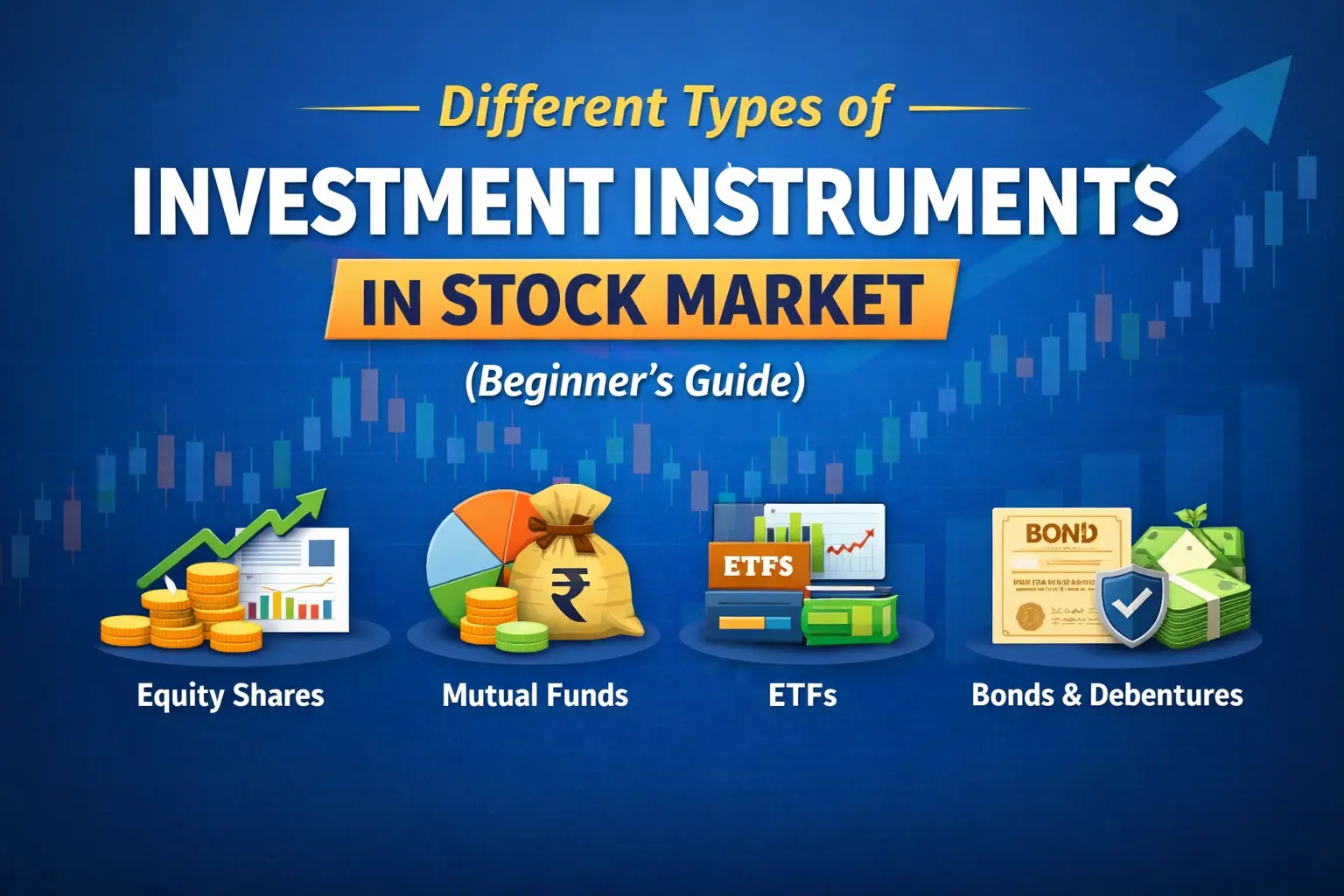
When beginners enter the stock market, most people think investing means buying shares only.
But the truth is — the stock market offers different types of investment instruments, and each one has its own risk level, return potential, and purpose.
If you are just starting your investing journey, this guide will help you understand everything in simple language.
1. Equity Shares (Stocks)
Equity shares mean ownership in a company.
When you buy shares of a company, you become a small part-owner of that business. If the company grows, you benefit. If it struggles, you may face losses.

How Do You Earn from Shares?
There are mainly two ways:
1. Capital Gain
Buy shares at a lower price and sell them at a higher price.
2. Dividend
Some companies share a portion of their profit with shareholders.
Example:
If you buy 100 shares of Infosys, you own a small part of the company.
Risk Level:
High (Prices fluctuate daily)
Best For:
Long-term investors who want wealth creation and can handle market ups and downs.
2. Mutual Funds
A mutual fund collects money from many investors and invests it in shares, bonds, or other assets.
It is managed by professional fund managers, so you don’t need to select stocks yourself.
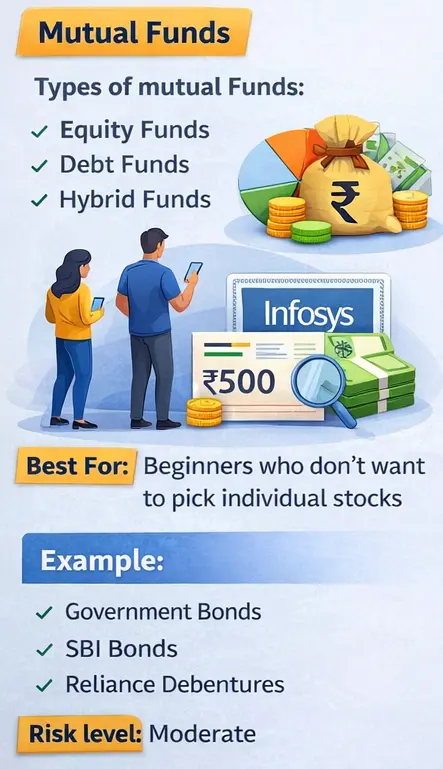
Types of Mutual Funds
- Equity Funds – Invest mainly in stocks
- Debt Funds – Invest in bonds and government securities
- Hybrid Funds – Mix of equity and debt
Example:
If you invest ₹500 in SBI Mutual Fund, your money gets combined with thousands of investors and is professionally managed.
Risk Level:
Moderate (Depends on fund type)
Best For:
Beginners who want diversification without worrying about stock selection.
3. ETFs (Exchange-Traded Funds)
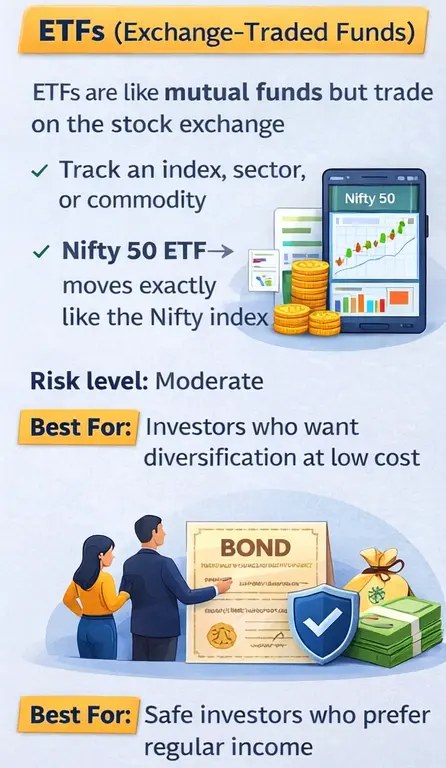
ETFs are similar to mutual funds but are traded on stock exchanges like shares.
They usually track an index, sector, or commodity.
Example:
A NIFTY 50 ETF moves almost exactly like the Nifty 50 index.
Think of ETFs as:
Mutual Fund + Stock Market Trading Flexibility
Risk Level:
Moderate
Best For:
Investors who want low-cost diversification and flexibility to buy/sell anytime during market hours.
4. Bonds and Debentures
Bonds and debentures are fixed-income investment instruments.
Here, you lend money to a company or the government. In return, you receive:
- Fixed interest (called coupon)
- Your invested amount back at maturity
Difference Between Bonds and Debentures
- Bonds are usually issued by governments or strong companies and are considered safer.
- Debentures are issued by companies and may carry slightly higher risk.
Examples:
- Government Bonds
- State Bank of India Bonds
- Reliance Industries Debentures
Risk Level:
Low to Medium
Best For:
Conservative investors who prefer stable and regular income.
Quick Comparison of Investment Instruments in Stock Market
| Instrument | Returns | Risk Level | Suitable For |
|---|---|---|---|
| Equity Shares | High (Capital Gain + Dividend) | High | Long-term growth investors |
| Mutual Funds | Moderate | Medium | Beginners & diversified investors |
| ETFs | Moderate | Medium | Low-cost diversified investing |
| Bonds/Debentures | Fixed Interest | Low–Medium | Safe income seekers |
Which Investment Instrument is Right for You?
There is no “one best” option.
- If you want high growth and can handle risk → Shares
- If you want balanced investing → Mutual Funds or ETFs
- If you want safety and regular income → Bonds
Your choice should depend on:
- Risk tolerance
- Investment goal
- Time horizon
- Financial stability
FAQs on Investment Instruments in Stock Market
1. Which is safer — shares or bonds?
Bonds are generally safer but provide lower returns. Shares are riskier but can give higher returns over the long term.
2. Can I start investing in mutual funds with small money?
Yes. You can start a SIP (Systematic Investment Plan) with as low as ₹100.
3. Which is better for beginners — Mutual Funds or ETFs?
Mutual funds are easier for beginners. ETFs are more cost-effective but require a demat account and basic market understanding.
4. Are bonds completely risk-free?
Government bonds are very safe, but company bonds and debentures still carry some level of risk.
Final Summary
Different investment instruments in the stock market serve different purposes.
Shares offer high return potential but come with high risk.
Mutual funds and ETFs provide diversification and balanced growth.
Bonds and debentures offer stability and fixed income.
As a beginner, always start with proper knowledge and invest according to your financial goals.