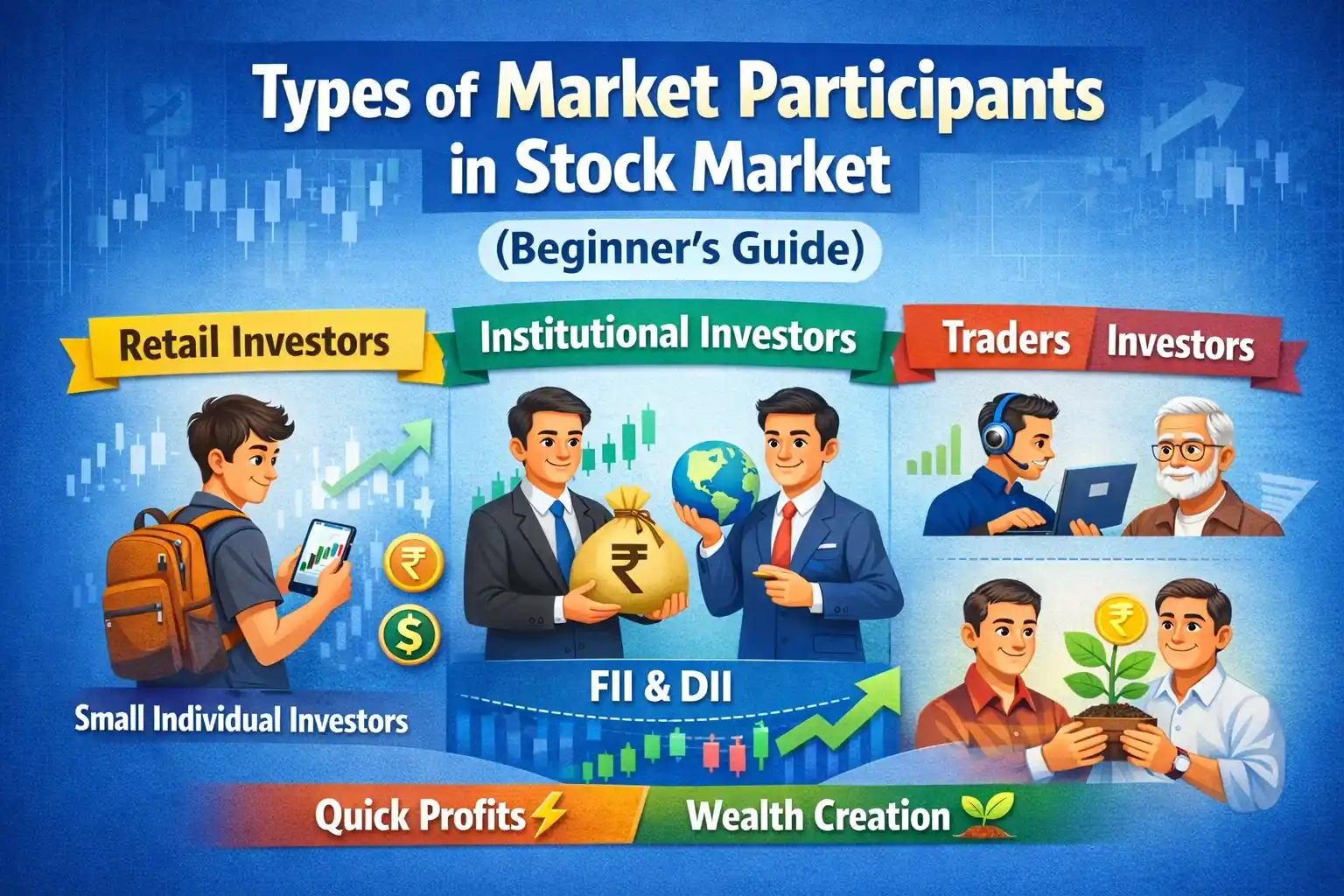
The stock market is like a busy marketplace with different types of people — some buy for the short term, some invest for the long term, and some manage huge funds.
These are called Market Participants. Let’s understand who they are.
Retail Investors
- Small individual investors like you and me.
- They invest their own money in stocks, mutual funds, or IPOs.
- Usually, the investment size is small compared to big institutions.
- Example: A student investing ₹1,000 in stocks through Groww, or a salaried person buying shares for long-term goals.
Retail investors are the backbone of the stock market but their decisions are often influenced by news, social media, and trends.

Institutional Investors
These are large organizations that invest huge amounts of money on behalf of others. They have professional fund managers, analysts, and research teams.
Two major types in India:
- FII (Foreign Institutional Investors)
- Investors from outside India (foreign mutual funds, pension funds, banks).
- Their buying/selling impacts the Indian stock market heavily.
- Example: If FIIs buy a lot of Indian shares, markets usually rise.
- DII (Domestic Institutional Investors)
In simple words:
- FII = Foreign money in Indian markets.
- DII = Indian money in Indian markets.
Traders vs Investors
Both buy shares, but their approach is different:
- Traders
- Buy and sell quickly (minutes, hours, or days).
- Focus on short-term profit.
- Use technical analysis, charts, and price movements.
- Example: Buying Infosys in the morning and selling the same day for a ₹50 gain.
- Buy and sell quickly (minutes, hours, or days).
- Investors
- Hold shares for months or years.
- Focus on long-term wealth creation.
- Use fundamental analysis (company performance, profits, business model).
- Example: Buying Reliance shares today and holding them for 10 years.
- Hold shares for months or years.
In short:
- Trader = Short-term player ⚡
- Investor = Long-term builder 🌱
FAQs on Market Participants
1. Who has more power in the market — retail or institutions?
Institutions (FII/DII) have more influence because they invest crores of rupees, while retail investors usually invest small amounts.
2. Can a retail investor become an institutional investor?
Yes, if an individual grows big enough to manage funds for others (like starting a mutual fund or firm).
3. Are traders and investors both important for the market?
Yes. Traders provide liquidity (money flow), while investors provide stability (long-term growth).
The stock market has different participants — retail investors, institutional investors, traders, and long-term investors. Together, they create balance in the market.